
RoboDocs: King’s surgeons perform 1,000 cases of robotic surgery in two years
12 January 2026 - King’s uses latest technology to speed up waiting lists and reduce post-op complications
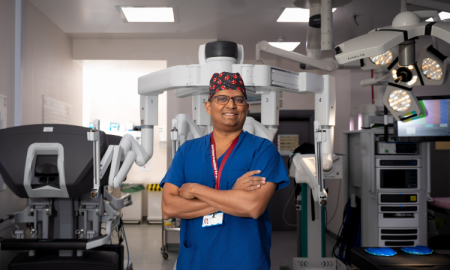
Surgeons at King’s College Hospital in London have performed 1,000 cases of robotic-assisted surgery in just over two years, helping ensure patients are treated without delay and recover more quickly than with open or laparoscopic (keyhole) surgery.
King’s currently has one surgical robot, which was generously funded by King’s College Hospital Charity.
Robotic assisted procedures are carried out by a surgeon sat at a special console connected to a robot which is designed to mimic the surgeon’s hand movements, enabling them to perform delicate procedures.
Using advanced features unique to robotic surgery that helps increase surgeons’ accuracy and productivity, more patients can be seen in the same amount of time, meaning those on waiting lists are not having to wait as long for their procedure.
Mr Sasindran Ramar, Consultant Bariatric, Metabolic and General Surgeon at King’s, who has performed 300 cases in just over 18 months, talked about the benefits of robotic-assisted surgery for both the surgeons operating and the patients receiving care.
“Using the robot has been a game-changer for me as a surgeon. The 3D immersive view and super magnification (nine times the magnification of laparoscopic surgery) allows for greater precision when performing a procedure.
“The platform we use shows us where tiny nerves and vessels are located, so there is much less risk of post-operative bleeding. And after the procedure, we can suture with even greater accuracy.”
Mr Ramar, who mainly performs bariatric surgery, hernia repairs and gall bladder removals, added: “Before the introduction of the robot, I could carry out two cases per list in the time available, but this has increased to four or five since I’ve been using the robot.
“Particularly with obese patients, laparoscopic surgery has its challenges, including access, visualisation and instrument manipulation. But robotic surgery gives us better visualisation, more precise manoeuvrability and valuable feedback in real time as we carry out the procedure.
“Additionally, and crucially, my patients have been delighted with the reduced post-operative pain and quicker recovery times, meaning they can go home within 24 hours of their surgery.”
Mr Amyn Haji, Clinical Director in Surgery at King’s College Hospital, and Chair of the Robotic Surgery Programme at King’s, said: “Performing our 1,000th robotic surgery is a significant milestone for us, and as a result, patients have benefitted from faster recovery, shorter hospital stays, better outcomes and fewer complications.
“Mr Sasindran Ramar and his colleagues at King’s are pioneering new techniques that are transforming care, and we are grateful to King’s College Hospital Charity for making this possible. We now hope to provide more teams with access to robotic-assisted surgery so that even more patients can benefit from this world-leading technology.”
Iona Joy, Director of Grants and Insight at King’s College Hospital Charity, said “We are excited that robotic-assisted surgery at King’s is delivering multiple benefits for many patients, including faster recovery times and reduced pain post-surgery. Also, it is wonderful that it enables treatment for people with health conditions that would make operations impossible without this impressive technology.
“Contributing to groundbreaking equipment like the surgical robot at King’s is one of the ways in which the Charity seeks to transform care and treatment for patients.”