Liver Twins: how a life-saving transplant made two strangers friends for life
22 September 2026 - Maya and Linda first met at a transplant reunion event in 2005.
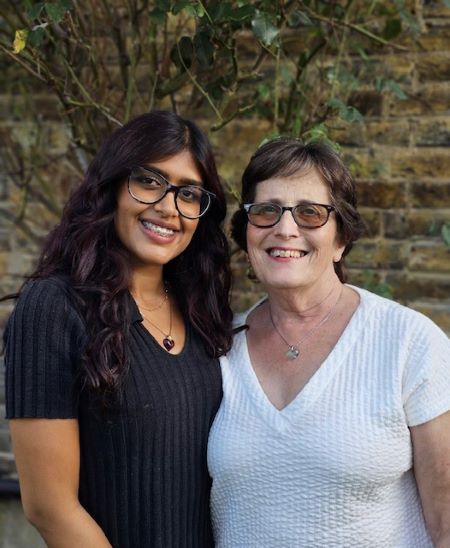
Maya Parmer, 24, (left) and Linda Fraser, 74, (right) have developed a life-long friendship following transplant surgery at King’s College Hospital, where they shared the same donated liver.
Both recipients and their families were introduced at a transplant reunion event in 2005, held by the Liver Unit at King’s to celebrate organ donation. It was from that moment Maya, who was then 4 years old, started calling Linda her ‘liver twin.’
Linda said: “It was incredibly emotional to meet Maya and her family and hear how her life had been transformed by the same organ donor who saved my life. I was introduced to Maya’s mother, Mona, and we just fell into each other’s arms and sobbed. It was an incredible moment.”
Maya was just one year old when she was matched with the same donated liver as Linda, then aged 51. Both were in desperate need of a liver transplant, and the organ was split into two parts to save both of their lives.
Sarah Coate, Lead Liver Transplant Coordinator at King’s, said: “Split liver transplantation means both an adult, and a child can benefit from the same donated liver. The majority of donated livers are transplanted as a whole organ. However, approximately one in 10 donated livers can be divided and used to help two carefully selected patients waiting for a liver transplant.
“King’s Liver Transplant Unit runs one of the largest transplantation programmes in Europe, and it is wonderful for us to see how the lives of our patients like Linda and Maya have been transformed, giving them the chance to make the most of life again. Our teams are always in awe of those who sign up to become organ donors to help save lives; without their and their loves ones’ generosity, our work would not be possible.”
Maya was born with biliary atresia, a rare condition affecting new-born babies, which can cause serious liver damage. Mona Parmar, Maya’s mother, said: “When the call finally came to say that a liver was available for Maya, it felt as though time stood still. Her health had been declining rapidly, despite her cheerful spirit and determination. Frequent hospital visits had become part of our family’s routine as we tried to manage each new symptom. So, when the news arrived—just three months after Maya had been added to the transplant list on her first birthday—our overwhelming feeling was relief. And hope.
“After the transplant, Maya’s recovery was astonishing. After 11 days, she was discharged home. A few days later, she took her very first steps—something we had been waiting so long to see.
“Our initial meeting with Linda is a moment I will never forget. It was the beginning of a very special bond. Over time, our families have stayed connected with Linda and her growing family—her children, their spouses, and her grandchildren. What started as a moment of gratitude has blossomed into a genuine friendship, one built on compassion, shared experience, and a life‑changing gift we can never truly put into words.”
Maya said: “Thanks to my donated liver, I feel like life is pretty normal. I have regular check-ups and take medication, but without my amazing organ donor, it could have been so different for my family and we will always be grateful.”
“We try and meet up once a year as we all lead busy lives,” Linda added. “Both our families have a special bond and get on so well. It’s been wonderful to see Maya grow up into an inspirational young woman, and be part of her journey.
“I had been living with liver disease for 18 years, and over time the damage to my liver had been steadily getting worse. I had chronic fatigue, and struggled with a severe loss of appetite. When the call came through to say a donated liver was available, it felt like a miracle. I knew that the donated liver would be split with a child, but had no more information about Maya until we met years later.”
Maya added: “Linda’s my liver twin, and I feel really lucky to her in my life. It’s amazing to think that we never would have met, had it not been for a stranger’s incredible gift of life.”
Since the establishment of the world-renowned Institute of Liver Studies at King’s 60 years ago, the Trust has been at the forefront of international breakthroughs in liver medicine, including the opening of the world’s first specialist liver intensive care ward in 1970, to the development of liver transplantation in 1989, and, in 1998, successfully introducing a programme of split liver transplantation.
Protecting the anonymity of organ donors is of paramount importance; organ donation recipients and their families are not provided with any information that could be used to identify the donor, such as their name, or place of donation. To find out more about organ donation, visit https://www.organdonation.nhs.uk/register-your-decision/donate/
If you are a journalist and would like to find out more about this story, please contact us at [email protected]